
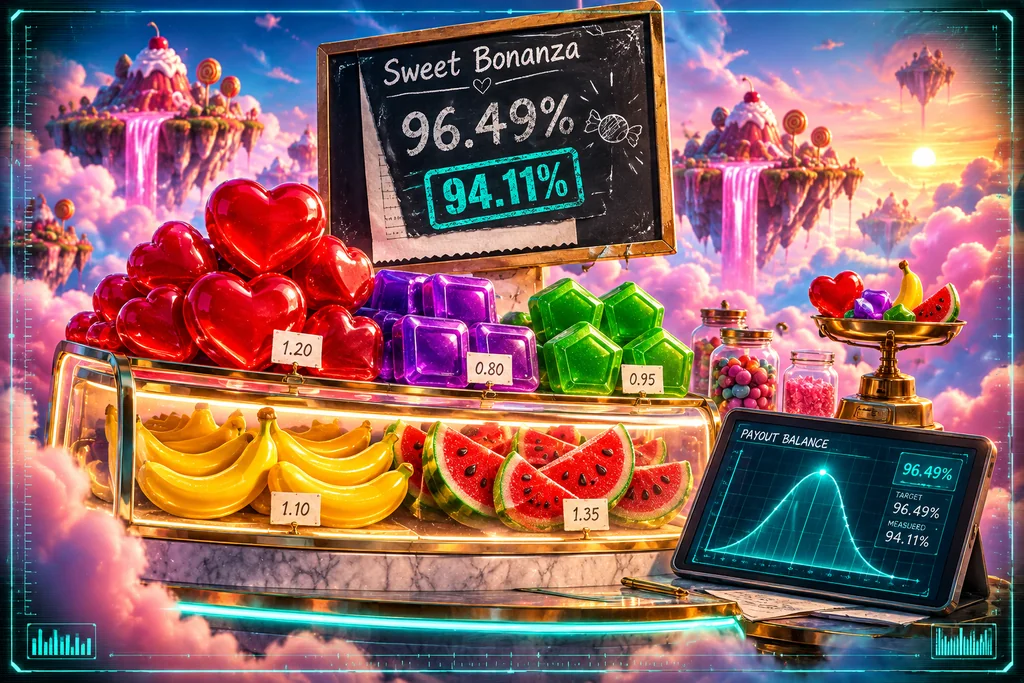
Picture a glass counter stacked with heart-shaped candies, purple squares, bananas and watermelon slices, each one with a little price tag turned face down. That is more or less how the lab at Slotester approaches a slot: lift every tag, add up the bill and print the total next to what the shop window promised. Its page on Sweet Bonanza does exactly that for the best-known candy game from Pragmatic Play, with 50,000 logged demo rounds, 250 purchased bonus rounds and a free demo that runs in the browser without an account.
The short version of the receipt: the game lists a return of 96.49%, and the demo server handed back 94.11% of everything staked across five separate sessions. The approximate 95% interval for that figure runs from 88.3% to 99.9%, so the listed number still fits inside it. Paying rounds arrived on 43% of spins, free spins triggered naturally once per 521 rounds, and the feature purchase recovered 85.88% of its cost.
Every figure below is pooled from the five runs, dated 3 September 2026 to 6 October 2026, and reflects the review as published (data as of 13 October 2026). Since new sessions of the same game keep being added and the headline numbers are recalculated over all of them, a later visit to the page may show a slightly different total.
What is Sweet Bonanza?
Sweet Bonanza is a 2019 release from Pragmatic Play played on a six-reel, five-row grid where symbols pay by count rather than by line: eight or more matching candies or fruits anywhere on the screen score, vanish, and let new symbols drop in for another chance. The declared RTP of the tested build is 96.49%, the volatility label is low, bets run from USD 0.20 to USD 300 per spin on the demo, and the opening screen advertises wins above 21,100 times the stake. Bombs carrying multipliers from 2x to 100x appear only during free spins, and the feature can be bought outright for 100 times the bet.
The paytable is the candy shelf in miniature. Red heart candies pay 10x the bet for eight or nine on screen, rising to 25x at ten or eleven and 50x once twelve or more land. Purple squares top out at 25x, green pentagons at 15x, blue ovals at 12x, and the fruit row underneath them runs from the apple at 10x down to the banana at 2x. The lollipop is the scatter: four or more start ten free spins, and four, five or six of them also pay 3x, 5x or 100x on their own.
What RTP did Sweet Bonanza actually return in the lab?
Across 50,000 ordinary rounds at a USD 2 stake, Sweet Bonanza returned 94.11% on the official Pragmatic Play demo server, against the 96.49% printed in the rules. The five sessions behind that pooled figure landed far apart: 87.28% on 3 September 2026, 94.77% on 18 September 2026, 86.00% on 21 September 2026, 98.21% on 26 September 2026 and 104.28% on 6 October 2026. Only the last of them finished above the stake.
Each run is a fresh session of 10,000 rounds, and each carries its own interval. The first run's band stopped at 96.1%, short of the listed return; the second and fourth bands held it; the third fell short again; the fifth, from 86.1% to 122.5%, held it with room to spare. Pooled together the band narrows to 88.3% to 99.9%, which is the honest way to read the 94.11%: a sample that leans below the listed figure without proving the listed figure wrong. The balance told the same story in plainer terms, starting the series at 100,000 credits and ending at 94,108.
Declared versus measured: the itemised bill
| Item | Declared or advertised | Measured by the lab |
|---|---|---|
| Return to player | 96.49% | 94.11% (95% interval 88.3% to 99.9%) |
| Sample | n/a | 50,000 rounds in 5 runs, USD 2 bet |
| Hit frequency | not stated | 42.86%, one paying round per 2.33 |
| Natural free spins | not stated | 96, one per 521 rounds |
| Bonus buy at 100x | USD 200 per ticket | mean 0.86x, 171 of 250 below price |
| Largest round | over 21,100x advertised | 648.95x, run 5, round 6759 |
| Largest round without free spins | not stated | 34.1x, run 3, round 2876 |
Two rows deserve a second look. The hit frequency means a paying round every two or three spins, but the midpoint paying round returned just 0.9x the stake, so most of those wins were smaller than the bet that produced them. And the largest round of the whole test, 648.95x, came from a natural feature that was extended from ten free spins to fifteen, not from any of the 250 purchased ones.
How often does Sweet Bonanza pay, and how much?
A win of some size landed on 42.86% of the 50,000 rounds in the Slotester test, and the typical one was worth 0.9x the stake. Of the 50,000 rounds, 28,568 paid nothing, 11,040 paid less than the bet, 4,520 paid between one and two times it, and 4,352 fell between 2x and 5x. Above that the shelf empties fast: 398 rounds reached 10x to 20x, 41 reached 20x to 50x, 22 reached 50x to 100x, 38 cleared 100x, and exactly one passed 500x.
- Longest run of blank spins in the series: 21, with the average dry spell at 2.34 spins.
- Deepest drawdown: 4,031 bets below the running peak, reached in the fifth run around spin 5181.
- Bankroll survival with the runs played back to back: a 50-bet pot was gone at spin 326, a 100-bet pot at spin 425 and a 200-bet pot at spin 1477.
The lab prints those survival figures as a measured example rather than a rule: another session could run dry earlier or never at all, and the page says so next to the chart.

How often do the free spins trigger without buying?
Lollipops started 96 natural features in 50,000 rounds, one per 521 spins on average, which the lab writes as 1.9 bHz, its unit for natural bonuses per 1,000 rounds. By session the count was 21, 21, 16, 20 and 18, and the wait could be long: in the third run the first trigger arrived only on round 2050. Every feature opened with ten spins; 20 of the 96 gained five more from extra lollipops, and none went past fifteen.
Free spins carried 19.3% of everything the ordinary rounds paid, and the average feature returned 94.6x the stake counting the free spins alone. Those features are where the big entries on the bill come from: the 348x round on spin 1531 of the second run, the 385.3x feature on round 1675 of the fourth, where 93% of the payout arrived on the tenth and final spin, and the 648.95x record of 6 October 2026.
Is the Sweet Bonanza bonus buy worth it?
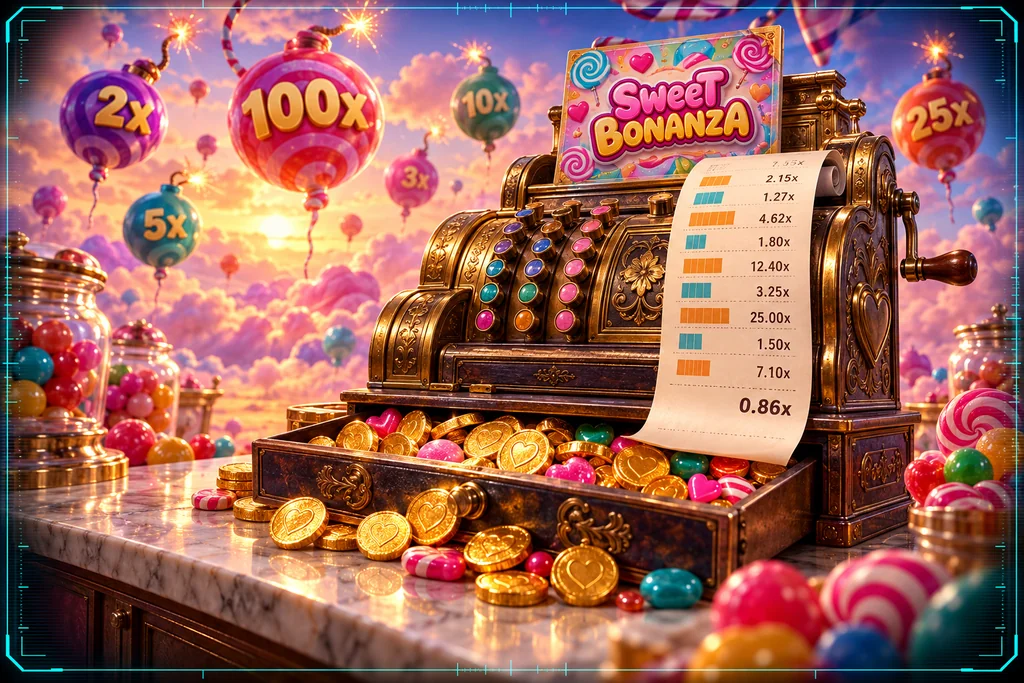
Not on this sample. Slotester bought the feature 250 times at USD 200, the 100x price, and the purchases returned USD 42,939.30 in total, 85.88% of the USD 50,000 spent, with an approximate 95% interval of 76% to 95%. The mean ticket paid 0.86x its price, the median 0.636x or USD 127.20, and 171 of the 250 finished below cost. Only 79 tickets broke even or better, 21 paid at least double, the best reached 4.48x and the worst 0.03x.
Session by session the purchases returned 86.17%, 72.73%, 85.75%, 92.54% and 92.19% of their cost, so even the best stretch of fifty tickets lost money overall. The top ticket of each session tells the same story in miniature: 3.79x, 2.76x, 3.25x, 3.23x and 4.48x, none of them within sight of the splash-screen promise. A bought feature lasted 11.1 spins on average, ranged from 10 to 25, retriggered 18% of the time and paid nothing beyond the trigger in 2% of cases. The lab adds a sober note for anyone comparing the ticket with waiting: the 521 stakes wagered between natural triggers are gross turnover across that wait, and the rounds in between return part of it, so the figure is not what a bonus costs net.
The bombs: sweet on screen, strict in the maths
The multiplier bombs are the centrepiece of the artwork and the easiest part of the game to misread. A bomb's value is added once the free spin stops tumbling and multiplies that spin's win only; nothing carries over to the next spin. If the spin produced no symbol win, a 100x bomb is worth nothing, and that happened to 11 of the 16 free spins in the test that ended on a 100x bomb. The heaviest multiplier sum that actually landed on a paying spin across five runs was 120x: the twelfth free spin of round 5938, fourth run, lifted USD 3.80 to USD 456.
Outside the feature the ceiling is low. The best ordinary tumble chain in 50,000 rounds paid 34.1x, an eleven-step cascade on round 2876 of the third run, and in the first run no base-game round exceeded 28x. Anyone chasing the 21,100x figure from the opening screen is chasing it through free spins or nowhere.
Where the recipe and the raw logs live
Slotester Lab publishes the full working behind the review, not just the totals. Each of the five runs has its own spin log in plain text, a round-by-round CSV, the raw server journal and a separate purchase file, every one of them with a SHA-256 checksum, so the 94.11% can be recomputed from the same data. The sessions run against Pragmatic Play's own demo server, every request logged, and a human editor checks each number of the draft against the log before publication. The home page, https://slotester.com/, serves as the lab's register: a sortable table covering all 142 slots tested by 13 October 2026, with measured RTP, bonus frequency, buy value and the biggest rounds side by side.
- Open the review and scroll to the Test record, where the five dated runs are listed.
- Download the rounds CSV of any run and compare its checksum with the one shown beside the link.
- Divide total wins by total bets in the file; the result should match the return printed on that run's plate.
The same page hosts the game's free demo, which runs inside the browser on Pragmatic Play's demo server, needs no sign-in and spends virtual credits with no cash value. The slotester.com review treats the demo as a reading aid for its numbers rather than a shop front.
Sweets in moderation: the responsible-play note
Everything in this article comes from a demo build running on virtual credits, and the demo is not a rehearsal for real money. The measured 94.11% describes 50,000 past rounds on one server, not a promise about any future session or any casino account, which may apply its own limits and settings on top of the game. Slots are entertainment that costs money, not a way to make it, and the test above prices that entertainment in detail: four of five sessions finished below their stake and most bought bonuses returned less than their price. Play only if you are 18 or older where that is the legal age, set a time and spending limit before the first spin, and treat the free demo as the place to learn how the candies fall.
Sweet Bonanza FAQ
What is the real RTP of Sweet Bonanza?
The rules state 96.49%. In the Slotester test the demo returned 94.11% over 50,000 rounds, with sessions ranging from 86.00% to 104.28%. The approximate 95% interval of 88.3% to 99.9% still contains the listed figure, so the sample leans low without contradicting it.
How volatile is Sweet Bonanza in practice?
The game is labelled low volatility, and the measured hit rate of 43% fits that label, but the money arrives unevenly. A typical paying round returned 0.9x the stake, while a single natural feature on 6 October 2026 paid 648.95x. The deepest drawdown in the series was 4,031 bets.
Can you play the Sweet Bonanza demo for free?
Yes. The review page carries the official demo, playable without sign-up on virtual credits supplied by the provider's server. The lab's numbers sit on the same page, so the demo and the data can be read together.
What is the biggest win recorded in the test?
Round 6759 of the fifth run, dated 6 October 2026, paid 648.95x the stake, USD 1,297.90 from a USD 2 bet, after a retrigger stretched its free spins from ten to fifteen. Without free spins no round exceeded 34.1x.
Does buying the bonus beat waiting for it?
In this sample neither path paid for itself, but the purchase was the costlier one on average: 250 tickets at 100x returned 0.86x of their price, and 171 of them lost. Natural triggers arrived once per 521 rounds and averaged 94.6x the stake from the free spins alone.
Is Sweet Bonanza rigged?
The test cannot answer that and the lab says so. A measured 94.11% from 50,000 demo rounds is one sample with a wide interval that includes the declared 96.49%; it is neither proof of fairness nor evidence against it. What the lab offers instead is the log with a checksum, so the figure can be checked by anyone.